



British Columbia’s commercial marine industry is moving into a practical new phase of electrification. The question is no longer whether battery-electric vessels can work. The focus is now where they work best, how they fit real operating schedules, and how shore-side energy systems can support demanding duty cycles.
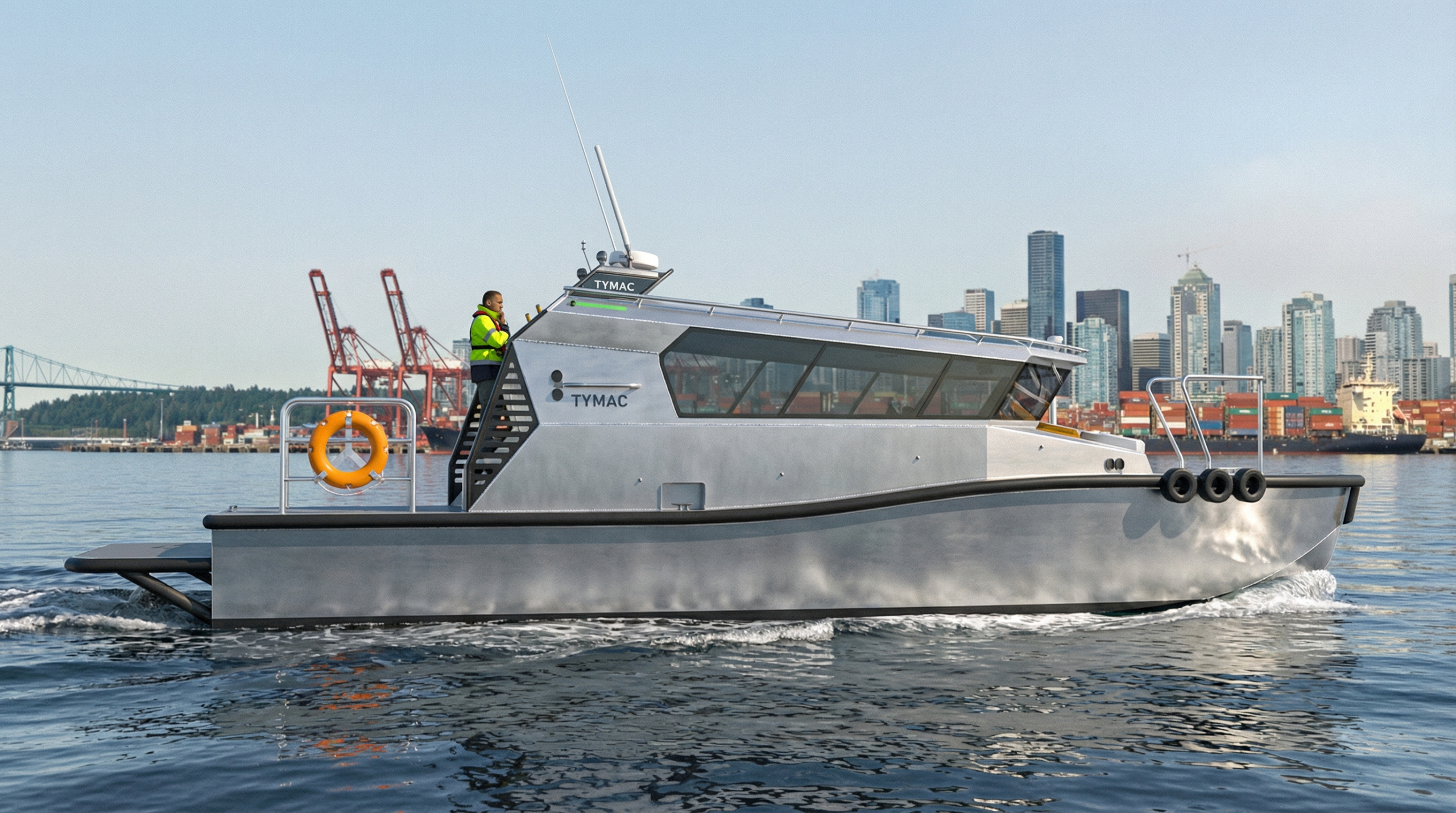
That shift is underway with Tymac Launch Service Ltd.’s new battery-electric launch vessel, designed by 3GA Marine Ltd., with hull fabrication now underway at Bracewell Boatworks Ltd.
The vessel remains consistent with the concept released in April 2025: an 11.9-metre aluminum launch with 12-person capacity, twin 310 kW-class electric propulsion, waterjet propulsion, 736 kWh+ of onboard energy storage, and an approximate 30-knot service speed. The vessel is being developed for harbour service, where speed, reliability, turnaround time, and operating cost matter.
A key development during construction has been the continued advancement of battery technology. 3GA Marine has been monitoring battery systems as the build progresses, and newer battery technology has now been selected that provides the opportunity to increase onboard energy capacity to approximately 930 kWh before final battery procurement and installation.
This increase from the original 736 kWh+ baseline improves endurance and operating flexibility without changing the core vessel concept. It also demonstrates the value of maintaining design flexibility during construction. In a rapidly advancing market, locking in major equipment too early can leave performance on the table. By evaluating battery technology before final installation, the project team has increased capability while staying aligned with the original intent.
The Tymac vessel is being designed as a working commercial launch, not a demonstration vessel. Based on the intended operating profile, it is expected to complete approximately 95 per cent of the jobs performed by comparable diesel vessels, excluding occasional long-distance assignments outside the normal daily duty cycle.
For a typical job, the vessel is expected to use approximately 30 per cent of its available onboard energy. In practice, the vessel can return to dock, plug in during passenger loading or job turnover, and recover meaningful energy during short stops of less than 10 minutes. Marine electrification succeeds when the vessel and charging strategy match the duty cycle.
The propulsion system has been selected with simplicity in mind. The vessel uses a compact, high-speed, permanent-magnet electric motor platform with high-power density and high efficiency, integrated with marine-grade power conversion, cooling, and control systems. The objective is diesel-equivalent performance while keeping the propulsion arrangement straightforward for crews and maintainers.
“For this vessel, simplicity was a major design driver,” says Daniel McIntyre, Vice President of 3GA Marine Ltd. “The technology is advanced, but the vessel still has to be straightforward for crews to operate and maintain.”
The project has also been supported by BC Hydro from the early feasibility stage. BC Hydro-funded energy studies helped assess the limitations, opportunities, and operating considerations for transitioning parts of Tymac’s fleet from internal combustion engines to battery-electric vessels and shore-side stored energy systems.
That study work was important because vessel electrification cannot be evaluated by looking at the vessel alone. A proper fleet transition study needs to consider duty cycle, route profile, grid capacity, charging windows, energy cost, vessel utilization, shore-side infrastructure, and practical limitations.
In parallel with vessel construction, 3GA Marine is supporting development of a shore-side battery electric storage system for Tymac with capacity of just over 2 MWh. The concept is straightforward: charge the shore-side battery system during lower-demand periods, then use that stored energy to support fast charging when the vessel returns to dock. This reduces peak demand impacts while providing high-power charging capability.
This is where the project becomes more than a new electric vessel. It becomes an integrated energy system. The vessel, dock, grid connection, shore-side battery storage, and operating schedule all need to work together.
The commercial case remains one of the strongest drivers. Depending on utilization, diesel price, and electricity rates, the battery-electric launch is projected to reduce fuel costs by approximately 80 per cent, with potential annual fuel savings in the range of $450,000 to $500,000. Maintenance costs are also expected to be lower by eliminating diesel engines and related systems, including fuel, exhaust, oil, and engine cooling systems.
The environmental benefit is direct. The vessel will produce zero direct operating emissions, reduce harbour noise, and improve passenger and crew experience through lower vibration and quieter operation.
3GA Marine is also applying the same approach to a new 17-metre, 40-passenger all-electric ferry under design for local service. That vessel builds on the same core philosophy: practical range, efficient propulsion, simplified onboard systems, and shore-side charging infrastructure matched to the real duty cycle.
For other vessel owners considering the transition from diesel propulsion to BC Hydro electric energy, 3GA Marine can support fleet assessments, duty-cycle analysis, feasibility studies, concept design, vessel integration, and shore-side charging strategies. Owners interested in understanding which vessels in their fleet may be suitable for electrification can contact Daniel McIntyre, P.Eng., Vice President of 3GA Marine Ltd., to review operating profiles and identify practical opportunities for fuel savings, emissions reduction, and fleet modernization.