



By Kathi Springer
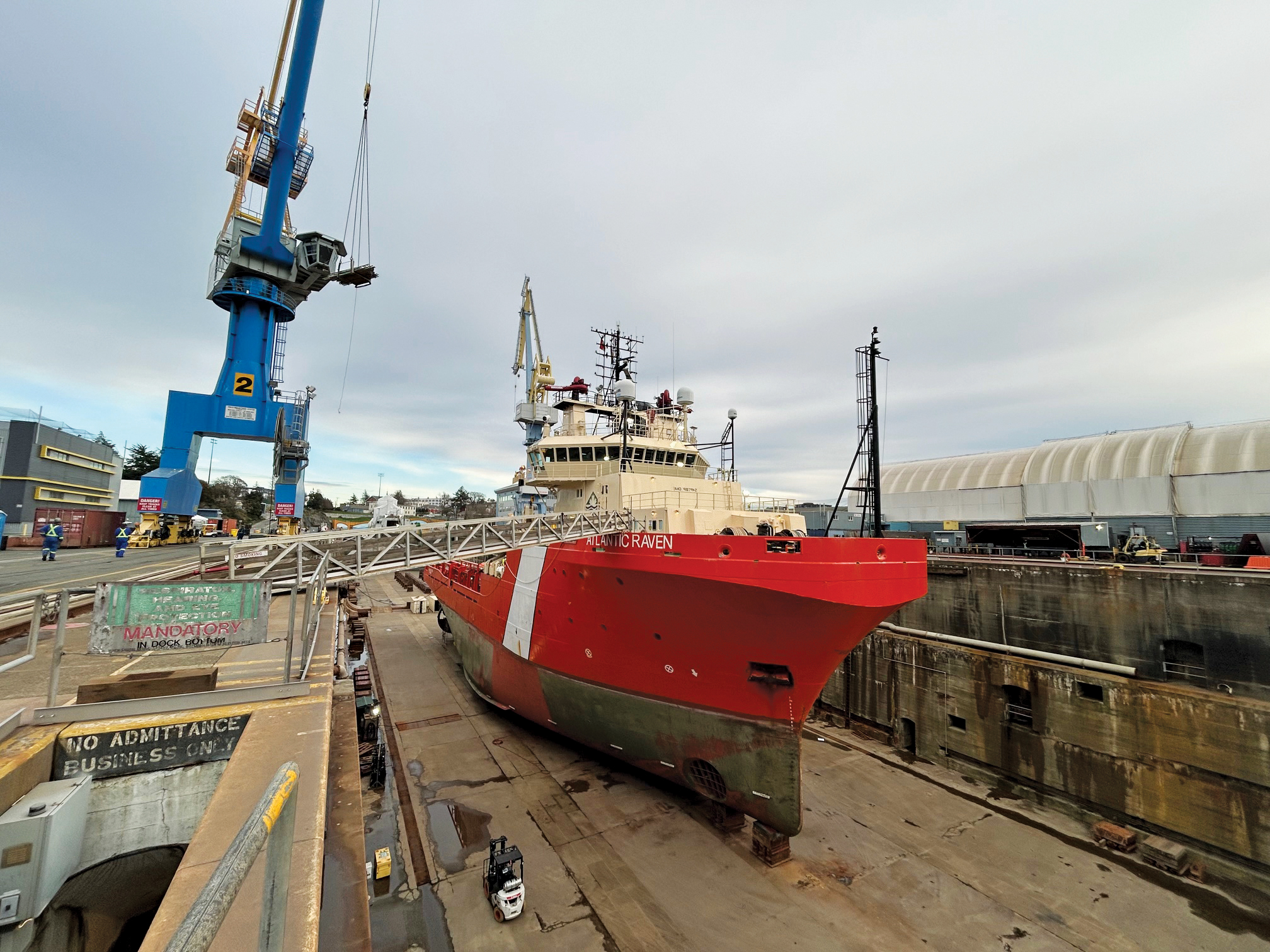
Point Hope Maritime (Point Hope) recently had the privilege of responding to a docking request from Atlantic Towing Limited. They were looking for prompt service support for the Atlantic Raven, one of two offshore support vessels in B.C. on charter to the Canadian Coast Guard to provide emergency response and towing services.
The Atlantic Raven had experienced an engine failure that necessitated a complex scope of work to facilitate an engine rebuild. This was Point Hope Maritime’s first opportunity to provide services to Atlantic Towing and Point Hope’s team was keen to demonstrate the quality of their services, expertise and problem-solving capabilities, and their dedication to the needs of their clients.
Atlantic Towing wanted the work completed as quickly as possible. As part of the engine rebuild, the engine’s crankshaft needed to be replaced. Early discussions with Atlantic Towing suggested that the only installation route for the new crankshaft likely required cutting a hole in the side shell of the vessel and a hole through an adjacent fuel tank. This approach was going to be costly and technically challenging, requiring complex welding procedures below the waterline.
Once in drydock, Point Hope’s team was better able to assess the circumstance, and in collaboration with Atlantic Towing’s team of engineers, discussions evolved to the possibility of bringing the new crankshaft into the vessel without having to cut a hole in the vessel’s hull. Instead, a complex rigging route with minimal clearance through the engine room and workshop was proposed. If deemed possible and safe, this approach would be less costly and reduce the Atlantic Raven’s stay in drydock.
Within a matter of hours, Point Hope’s team returned with 3-D scans of the complete transport route and verified there was indeed another way to rig the crankshaft to fit into the vessel without requiring a side shell cutout. Everyone got to work immediately.
United Engineering’s team (Point Hope Maritime’s sister company located on site), had already removed the damaged crankshaft in pieces prior to the docking period. United Engineering’s skilled machinists had reconditioned a spare crankshaft to virtually new condition and transported it to the Atlantic Raven at the Esquimalt Graving Dock. The careful plan to re-install the reconditioned crankshaft was successfully executed by Point Hope’s team and the focus shifted to rebuilding the damaged engine. Teams from Point Hope Maritime and United Engineering worked seamlessly with Atlantic Towing’s representatives under tight timelines and completed this impressive project without delay.
” We have been incredibly impressed by the professionalism of the team at Point Hope” says Paul Kearley, Senior Marine Engineer, Atlantic Towing Limited. “Not only were they able to squeeze us into their full docking schedule, but their solution and their expertise also saved us time and money. The integration of machining services from their sister company, United Engineering and the precision quality of the overall work on the crank shaft was exceptional.”
Side bar:
With a Bollard Pull of 162 metric tonnes, the Atlantic Raven is one of the most powerful and versatile vessels on our coast. Her home port is Victoria, but she and her sister ship, the Atlantic Eagle (Bollard Pull of 158 metric tonnes) are most often deployed up and down Canada’s west coast and offshore waters.
Each vessel is highly valued for their world-class emergency response capabilities including emergency towing, fire fighting, and oil pollution response. The Atlantic Raven has a crew of twelve specialized Atlantic Towing mariners on board responsible for the operations of the vessel and supporting the crew of Canadian Coast Guard. Depending on the deployment, up to twelve additional Coast Guard seafarers may be on board in what is referred to as a joint crew model performing specialized job duties such as search and rescue.
While it is critical to always respect the power of the sea, both the Atlantic Raven and Atlantic Eagle are well known and trusted for their all-weather capabilities. Having spent time working in the Grand Banks on the east coast, a region known for some of the worst sea conditions on earth, and in the wild waters off Baffin Island in Canada’s arctic, the Atlantic Raven and the Atlantic Eagle are the ideal marine assets for the Canadian Coast Guard’s diverse and often critical offshore operations.
Atlantic Towing has more than twenty vessels in its fleet with vessels that service the demands of both ports and offshore operations across the world.
Side bar stats:
The Atlantic Raven has a length of 75 metres and a beam of18 metres and was built in 1999 by the Orskov shipyard in Denmark. It is powered by 4 Bergen medium speed diesel engines, delivering over 14,000 horsepower.